
How might we move small farms towards sustainability?
Future Roots
Loughborough University| UX & Service Design MA | 2024
When first addressing this question, it seemed farmers needed clearer and more practical information. Instead, I discovered that what they called “practical” was deeply emotional, a starting point that felt safe, social, and true to their identity.
At a Glance
Future Roots is a service I designed during my MA to help small UK farmers take their first step toward sustainable agriculture. Working to understand why farmers weren’t engaging with existing schemes and to shape a service that helped them move towards a sustainable future. I conducted the full research and design process, from behavioural investigation and co‑design to iterative service and UI prototyping.


(Graphic of my design process and steps taken)
The Challenge
Despite strong policy pushes like the Sustainable Farming Incentive (SFI), small UK farmers had shown low uptake of sustainable practices. On paper, support existed for sustainability. In practice, farmers weren’t engaging.
The question became:
What’s stopping small UK farms from taking the first step toward sustainability and how might a service help them start?

(I made this representation of the opportunity context using the three horizons framework (Baghi,Coley and White, 1999) to frame the long-term opportunity context.)
The Process
Data Collection
1.
Untangling the Context
I began with a wide-angle view of the agricultural ecosystem to untangle context and start pulling significant threads. Through secondary research and conversations with agricultural professionals, I mapped the policies, pressures, and structures surrounding small farms.
The Process
Data collection
1. Untangling the Context
I began with a wide-angle view of the agricultural ecosystem to untangle context and start pulling significant threads. Through secondary research and conversations with agricultural professionals, I mapped the policies, pressures, and structures surrounding small farms.

(Slides from project presentation, showing initial ecosystem map I made and key quotes from farming professionals)
This initial research highlighted surface-level practical barriers; being unsure what to do, a lack of incentives and information, or believing their farm produced too few emissions to matter.

(Top findings from initial secondary research that helped to set the wider context)
To explore the deeper whys of the situation, I introduced the COM-B behavioural change framework (Capability, Opportunity, Motivation) to guide enquiry as I focused in on farmers' experiences.
Do farmers have the capacity, opportunity and motivation to act sustainably?

(Illustration of the Com-b model as shown in my final project presontation)

2. Finding the Human Why
Shifting focus to farmers themselves. I used mixed ethnographic methods to uncover there perspectives, systematically addresing research questions:
• Semi structured interviews with farmers, investigating barriers and inablers.
• A sorting activity placeing sustainable methods on a scale of appeal and understanding.
• On farm observation to see daily pressures and unconscious routines.
• A farmer focus group exploring “What if…” scenarios around sustainability.

(Some key quotes about defining sustainable farming from the interviews I conducted with farmers)
Farmers spoke about time, money, and uncertainty, but there was something beneath the surface. Many described sustainability as something outside their farming identity, even when they cared about the environment.
This emotional disconnect and defensiveness to change became a critical thread.

(---)
Data Analysis
3. Making Sense of the Data

A breakthrough came in data analysis when I refocused on the COM-B model again, using its three factors to categorise findings.
This highlights the distinction between External barriers (resources, time, access) and Internal barriers (identity, defensiveness, uncertainty).
Raising the question: What was the key barrier to the adoption of sustainability rooted in? And what should the solution focus on?

(---)
4. Personas become a journey (transition)
Initially, personas felt scattered. Farmers varied widely in resources, land, and experience. But when I reframed them as proto-personers along a readiness scale, the patterns clicked: Wait and See → Plan and Try → Commit and Act
Analysis revealed that many small UK farmers are resource-poor and many operate from a “Wait and See” mindset, driven by defensiveness to change, a disconnect between sustainability and their farming identity, and the perceived lack of a 'practical starting point'.
The design aim became clear: How do we help a Wait and See farmer become a Plan and Try or Commit and Act farmer?

(My representation of the cognitive behavioural factors I found affecting farmers move to sustainable farming aligned with my personas aligned to a scale of adoption readiness)
The design aim became clear:
How do we help a Wait and See farmer become a Plan and Try or Commit and Act farmer?
And an opportunity statement for a service targerting 'wate and see' farmers was assembled around this permis:
Selected Opportunity
There is an opportunity for a service to support small UK farmers with limited resources, who want to profitably move their farms into a sustainable future. But can't see a practical starting point, and feel defensive of change.
Concept Discovery
5. Finding the Gap
Returning to the ecosystem map with this new lens revealed something important: The problem wasn’t a lack of services, information or options; it was a lack of connection.
'Wait and see' farmers didn’t see existing resources as for them. The service needed to act as an onboarding for sustainable agriculture. An emotionally approachable, manageable and 'practical' starting point.

(---)
6. What would onboarding mean?
I ran co‑design sessions and spoke with stakeholders to explore what this onboarding experience should look and feel like. Surfacing emotional drivers and past service experiences, in Brain Bank and collage tasks.


(---)
Through research, farmers said they wanted something “practical.” But for them, “practical” meant:
-
seeing other farmers do it
-
feeling part of something collective
-
not devaluing food production
-
no large/fundamental changes
-
aligning with their identity as stewards of the land
This insight was pivotal. For farmers, practicality was also emotional.

Therfor the service needed to:

7. Uniting idears
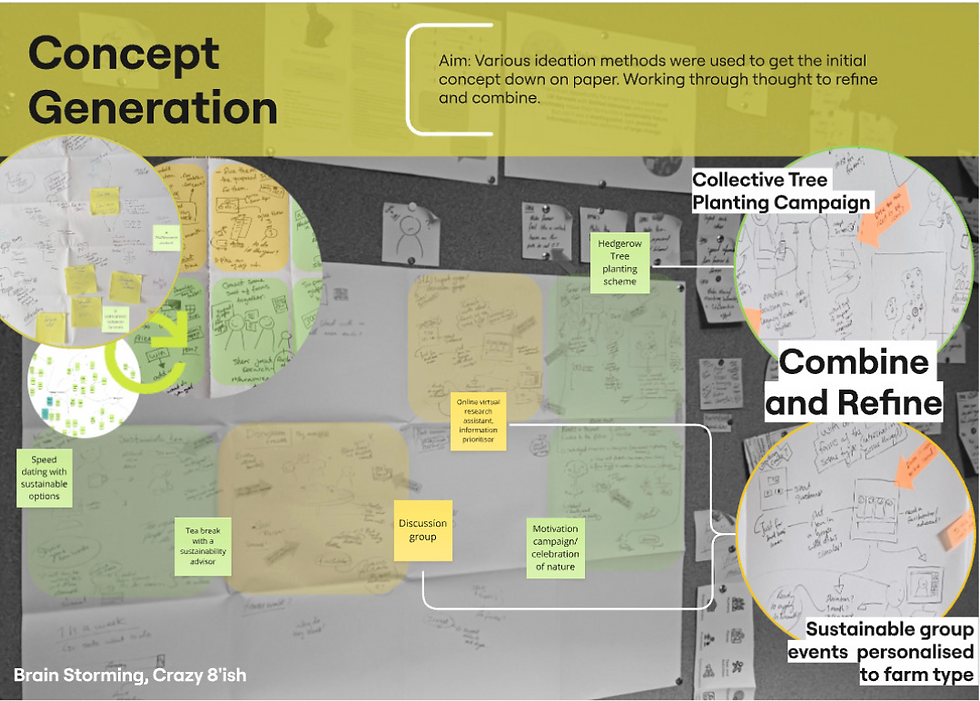
Throughout ideation I continued to balance these practical needs with the emotional drivers that motivate behaviour change. Feedback from ongoing co‑design sessions helped me refine and combine these strands into an early concept that delivered essential information while also supporting mindset shifts. In a format that unified both elements in a coherent, manageable experience.
The Idea
-A month of events (a starting point, not waiting for them to act).
-Information events for farmers (relevant to them)
-Community enviromental action (can see others acting, appeal to there identity in nature)

(---)
Concept Development
8. Getting into the details
As I moved into iterative prototyping, I zoomed in and out on service details to refine both user touchpoints and the broader service structure these interactions fit into.
Through storyboards, co‑design sessions, and low‑ to high‑fidelity prototypes, I explored questions such as:

What’s the max viable commitment a ‘wate and see’ farmer will accept?
Concept Development
5. Iterative Development
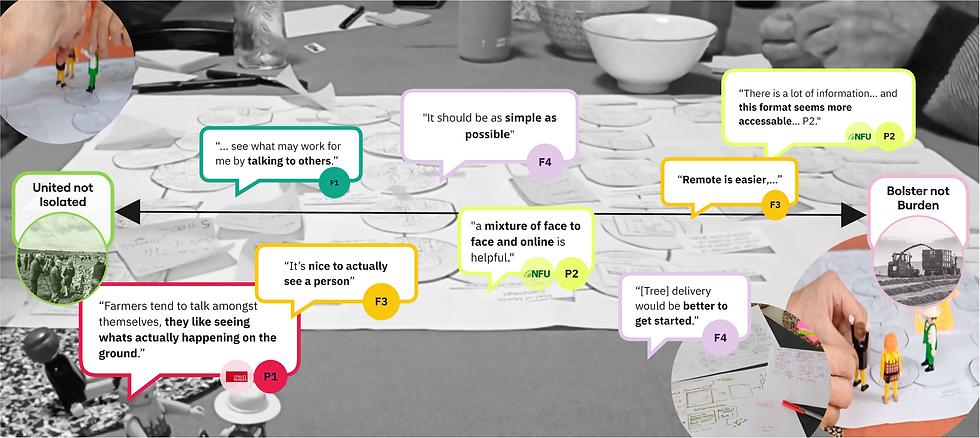
Iterative Development Across development, I continually balanced two forces that shaped every design decision, these represented in tow of the service needs:
-
Bolster not Burden: simple onboarding and low‑effort participation
-
United not Isolated: the emotional driver that actually motivates change
(---)
The challenge was making the experience manageable for farmers while keeping the meaningful, identity‑based action at its core. Testing and co‑design focused on clarity, appeal, and why this format would motivate action.
Key iterations included:
-Packaging events into recommended ‘routes’
-Offering online routes with optional in‑person events
-Ending with a shared meet‑up to reinforce community momentum

(---)
Using storyboarding, co‑design, low‑ and high‑fi prototypes, video prototyping, and stakeholder feedback, I iterated on both the farmer‑facing journey such as UI touchpoints and the back‑end service model. This loop refined the service blueprint, tested feasibility, and shaped an onboarding experience that felt both doable and meaningful to farmers.
The Solution

(---)
Future Roots
Future Roots is a not-for-profit service for small U.K farmers, working as an on boarding to farming’s sustainable future. It meets farmers where they are, using collective action as an emotional hook and educational events to provide practical aid.
Partnering with agri-environmental organisations, it delivers a month-long campaign of collective environmental activities alongside practical learning sessions. Fostering unity, respects farming values, and provides a manageable first step toward sustainability suited to real-world constraints.
Two Core Elements:
-
Collective Action: A free tree planting campaign with connective digital recording to see collective action of community.
-
Educational Events: A practical route of relevant of flexible online and in person events over the month to build capability and confidence.
Alignment with the Four Design Principles
-
Bolster, not Burden: Offers a tailored, schedule of local and online events, providing a low-commitment entry point that fits farmers’ busy lives and avoiding overwhelming choices.
-
Positive, not Pressuring: Uses collective tree planting as an emotional hook, tapping into farmers’ connection to nature to encourage participation with pride, not guilt.
-
United, not Isolated: Fosters peer support through a month-long campaign and collective tree-planting through a live map showing collective impact, turning sustainability into a shared journey.
-
Identity-empowering, not Endangering: Partner with trusted agri-organisations to present sustainability in familiar terms, respecting farmers’ experience and helping them see sustainable practices as an extension of their role
Designed for growth: Conceived as an on boarding experience, the services aim is to help farmers eventually outgrow it, adapting as attitudes and needs change and sustainability is normalised as part of everyday farming.


(Consideration of long term service impacts and plans for the future, as shown in project presonataion and representation of collective tree planting action)
Outcome & Reflection
-
Future Roots demonstrates how behavioural insight and co-design can unlock change in complex systems. By grounding the service in farmers’ lived experiences and emotional realities, the design supports meaningful, lasting transformation.
-
This project strengthened my expertise in behavioural design, systems thinking, and strategic UX research skills I can apply to real-world challenges with confidence.

(UI prototype of event route selection with user quote examples)